COOCH BEHAR

The Narayan Dynasty
BRIEF HISTORY
13-guns.
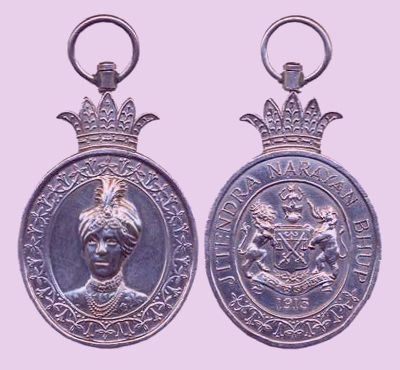
Accession Medal 1913 in silver - obverse (L) and reverse (R).
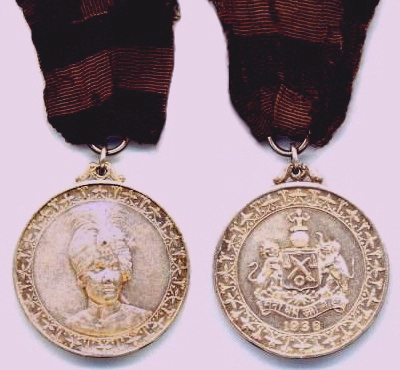
Investiture Medal 1936 - obverse (L) and reverse (R).
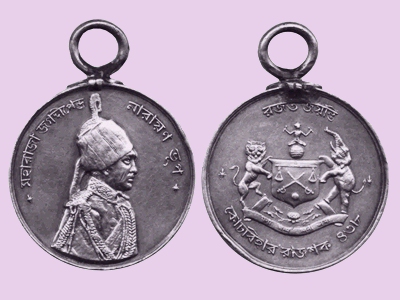
Silver Jubilee Medal 1947 - obverse (L) and reverse (R).
Cooch Behar: from Koch (the principal tribe of the area) and vihara (abode), thus ‘land of the Koch’.
Diwan Deo: hereditary title borne by the Chief Minister, held by a junior branch of the ruling family.
Hazuri: commander of 1,000 men.
Kanyaptri: a virgin who accompanied the bride of a ruler, and subsequently served in the Royal household as a companion. Her sons by a ruler could succeed, if he died without issue by his full wives.
Nawab: commander of 6,000 men.
Nazir Deo: Lord Guardian, hereditary title borne by the commander-in-chief of the Army, held by a junior branch of the ruling family.
Rajvansi: Hindu caste descended from the original Koch tribe, native to the area. For several centuries, they were not regarded as ‘pure Hindu’ by most other castes due to the consumption of pork, and the prevalence of certain forms of widow and gandharva marriage not sanctioned by the Hindu shastras. These practices being outlawed by state legislation, adherence to them died out within a generation.
Saikia: commander of 100 men.
Thakuria: commander of 20 men.
Umara (or Omra): commander of 3,000 men.
Annual Administration Report of the Cooch Behar State for the year 1877-78 to 1940-41. Cooch Behar State, Education Department, Cooch Behar. Hemanta Kumar Rai Barma. Kochbiharer Itihas. Second editon, 1988.
Burke’s Landed Gentry, Burke’s Peerage Ltd. In conjunction with Shaw Publishing Co. Ltd., London.
Burke’s Genealogical and Heraldic History of the Peerage, Baronetage and Knightage. Burke’s Peerage Limited, London, 1900-1959.
Harendra Narayan Chauduri (comp.). The Cooch Behar State and its Land Revenue Settlements. Cooch Behar State Press, 1903.
Gayatri Devi and Santha Rama Rau. A Princess Remembers, The Memoirs of the Maharani of Jaipur. J.P. Lippincott Company, Philadelphia, 1976. The Cooch Behar Gazette. 1936 & 1947. Cooch Behar State Press.
Munshi Jadunth Ghose (translated by Rev. R. Robinson). The Rajopakhyan: Or, History of Kooch Behar. Baptist Mission Press, Calcutta, 1874.
Russell Harris (comp.). The Lafayette Photographic Collection at the V&A Image Library, Kensington, London, 2000.
Major Francis Jenkins. “Sketch of the Connections of the British Government with Koch Behar”. Selections from the Records of the Bengal Government. No V, pp30-46, genealogical table. F.Carbery, Military Orphans Press, Calcutta, 1851.
Francis Jenkins. Diary and Notes of Captain F. Jenkins, Commissioner and Agent to the Governor General for Assam and the North Eastern Part of Rungpore, 1837-1841. Baptist Mission Press, Calcutta, 1868.
Nicholas Mander. Varnished Leaves: a biography of the Mander family of Wolverhampton, 1742-1998. http://www.owlpen.com
D Nath. History of the Koch Kingdom, c. 1515-1615. Mittal Publications, Delhi, 1989.
SPECIAL ACKNOWLEDGEMENTS:
Dr. Morris Bierbrier, FSA.
Marcus Mander.
Father Lawrence Ober, SJ.