-
JORDAN
-

-
Al-Hashimi Dynasty
-
ORDERS & DECORATIONS
-
The Order of Hussein ibn Ali (Wisam al-Hussein ibn Ali): founded in honour of his father, by King 'Abdu'llah I on 22nd June 1949. The Grand Cordon class was introduced by King Hussein on 23rd September 1967. Awarded in two classes (1. Qiladat al-Hussein ibn Ali - Collar: awarded to Heads of State, and 2. Grand Cordon: awarded to consorts of heads of state, senior Jordanian and foreign princes and princesses).
-

-
The Order of Hussein ibn Ali - collar & collar badge (A), sash badge (L) and breast star (R).
- The Order of Military Glory (Wisam al-Iftiqhar al-Askari): founded in honour of Glubb Pasha by King Hussein I in 1956, awarded in brilliants, in one class only. Copyright© Christopher Buyers
-

-
The Order of Military Glory - collar & collar badge
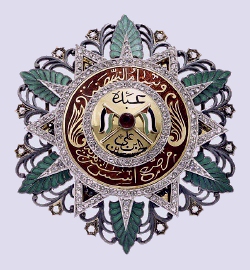
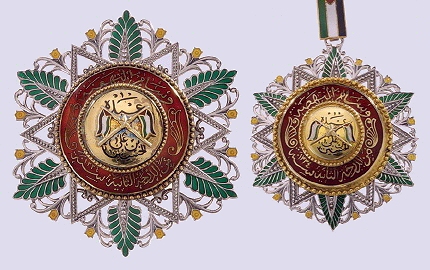
- The Order of the Renaissance (Wisam al-Nahda): founded by King Hussein of the Hijaz in 1917, in honour of the Arab renaissance following the revolt against Turkish rule and to reward those who served in the war of liberation. Appropriated and modified by King 'Abdu'llah I of Jordan in 1925, with the permission and approval of his elder brother King 'Ali ibn Hussein of the Hijaz. The order is awarded for the highest civil or military services to the Kingdom of Jordan. It comes in a special class (Mourassa - Grand Cordon in brilliants - reserved for Royalty and foreign Heads of State) and five ordinary classes (1. Grand Cordon, 2. Grand Officer, 3. Commander, and 4. Member Fourth Class). Attached to the order is a silver medal.
- Copyright© Christopher Buyers
-
-
The Order of the Renaissance - Grand Cordon (special class), breast star in brilliants.
- Copyright© Christopher Buyers
-
-
The Order of the Renaissance - Grand Cordon, breast star (L) and sash badge (R).
- The Order of the Hashimite Star (Wisam al-Najma al-Hashimiya): founded by King Hussein in 1971 to recognise and reward act of supreme heroism and distinguished service in the face of the enemy. Awarded in a single class, a gilt and enamelled star. Additional acts of heroism may be recognised by the award of a gilt miniature of a sabre attached to the medal ribbon. Copyright© Christopher Buyers
-
-

-
The Order of the Hashimite Star.
- The Order of Military Gallantry (Wisam al-Iqdam al-Askari): founded by King 'Abdu'llah I in 1946 to recignise acts of gallantry by members of the Jordanian armed forces. Amended and updated by King Hussein. Awarded in three classes (1. Class I in chromium, 2. Class II in silver, and 3. Class III in bronze).
The Order of the Star of Jordan (Wisam al-Kawkab al-Urduni): founded by King 'Abdu'llah I on 22nd June 1949 in celebration Jordan's independence. Awarded for both military and civil merit in five classes (1. Grand Cordon, 2. Grand Officer, 3. Commander, 4. Member Fourth Class, and 5. Member Fifth Class). Attached to the order is a silver medal.Copyright© Christopher Buyers
-


-
The Order of the Star of Jordan - Grand Cordon, breast star (L) and sash badge (R)
- The Order of Independence (Wisam al-Istiqlal): founded by King Hussein of the Hijaz in 1921 in celebration of Arab independence and as a reward for those who helped to achieve it. Appropriated and modified by King 'Abdu'llah I of Jordan in 1925, with the permission and approval of his elder brother King 'Ali ibn Hussein of the Hijaz. Now conferred on Jordanian and foreign citizens as a general reward for exmplary and meritorious services to thre state. The order is awarded in five classes (1. Grand Cordon, 2. Grand Officer, 3. Commander, 4. Member Fourth Class, and 5. Member Fifth Class). Attached to the order is a silver medal. Copyright© Christopher Buyers
-


-
The Order of Independence - Grand Cordon, breast star (L) and sash badge (R)
- Al-Hussein Order of Military Merit (Wisam al-Istahaqaq al-Askari al-Husayniya): founded by King Hussein in 1976 to reward distinguished services by members of the Jordanian armed forces. Civilians may also receive the order in reward for exceptional services in the defence of the kingdom. The order is awarded in five classes (1. Grand Cordon - awarded to general officers and above, 2. Grand Officer - awarded to full colonels and above, 3. Commander - awarded to field officers and above, 4. Member Fourth Class - awarded to officers below field rank, and 5. Member Fifth Class - awarded to other ranks).
- Copyright© Christopher Buyers
-


-
Al-Hussein Order of Military Merit - Second Class, miniature badge, neck badge and breast star (L) - Fifth Class, badge (R).
- Al-Hussein Decoration for Distinguished Service: instituted by King Hussein in 1976 to reward distinction and achievement in particular fields of endeavour, including philanthropy, literature, the arts, science, scholarship and education, industry and commerce, or public service. Awarded in three classes.
- Copyright© Christopher Buyers
-

-
Al-Hussein Decoration for Distinguished Service - First Class, sash badge.
- Copyright© Christopher Buyers
-
- Copyright© Christopher Buyers
- I would be grateful to hear from anyone who may have changes, corrections or additions to contribute. If you do, please be kind enough to send me an e-mail using the contact details at:
- Copyright© Christopher Buyers
-
Copyright©Christopher Buyers, August 2000 - February 2022