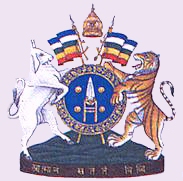
1775 - 1791 H.H. Maharao Raja Shri Sawai Pratap Sinhji Bahadur, Rao Raja of Alwar. b. at Macheri, Jaipur, 1st June 1740, son of Rao Mahabat Singh, Thakur of Macheri, under Jaipur, educ. privately. Entered the service of the Maharaja of Jaipur at the age of seventeen, but forced to flee because of jealousies aroused by his ambitions. His military exploits under Jaipur made him famous, subduing the chiefs of Uniara and breaking the Maratha siege of Ranthambhor. He then entered the service of the Maharaja Suraj Mal of Bharatpur. Quitted his service three years later when Suraj invaded Jaipur and was rewarded by his former chief by the restoration of his jagir of Macheri. Senior Mbr Jaipur Council of Regency 1768-1777. He gradually extended control over Rajgarh, Tehla, Malakhera and Thana Ghazi. Sided with the Imperial forces when they crushed the Jats at Barsana. Took Bala Qila, the fort of Alwar, 23rd November 1775 and established himself as an independent ruler. Rewarded with an Imperial mansab of Panch hazari, granted the hereditary title of Rao Raja and Royal insignia, 25th December 1775. Confirmed his independence from Jaipur, 13th April 1778 (by refraining from attending the installation ceremonies of Maharaja Pratap Singh). Formally invested as an ruler of Macheri as a direct possession by the Emperor in person, at the Imperial Camp, Amirpur, Amirnagar pargana, near Jaipur, 19th February 1779. Took control of Lachmangarh, Ramgarh, Bansur, Behror, and Mandawar, incorporating these within his new state. Removed his capital from Rajgarh to Alwar in 1775, which he had wrested from the Jats two years before. Assumed the title of Maharao Raja Shri Sawai (not recognised by the Mughal authorities, and thus treated as personal, and not an hereditary territorial designation). m. H.H. Rao Rani Gaurji Sahiba [Rajmata Sahiba] (d. after 1791). He d.s.p. at Bala Qila, Alwar, 26th September 1791 (succ. by his adopted son).
1791- 1815 H.H. Maharao Raja Shri Sawai Bakhtawar Singhji Bahadur, Maharao Raja of Alwar. b. at Thana, 1779, younger son of Thakur Dhir Singh, of Thana, educ. privately. Adopted by his distant relative, Rao Raja Pratap Sinhji, and invested as his Heir Apparent, 1790. Succeeded on the death of his adopted father, 26th September 1791. Formally invested at the Bala Qila, Alwar, 24th November 1791. His state was repeatedly attacked by the forces of Maharaja Mahadji Scindia, until the Mahrathas were finally defeated by Lord Lake and their power broken at Laswari, in Alwar, 1st November 1803. Bane Singhji then entered into a treaty of an offensive and defensive nature with the HEIC 14th November 1803 (in which he was recognised in the hereditary title of Maharao Raja Shri Sawai). Granted Hariana (later exchanged for Tijara), Rath and several areas within Mewat, in recognition of his services, 28th November 1803. A further treaty with the HEIC was concluded 16th July 1811, in which the Honourable Company assumed paramountcy in external relation. m. several wives, including (first) at Jodhpur, 1793, H.H. Shri Rathorji Rani Sahiba, daughter of Thakur Suriya Mal, of Kuchaman, under Jodhpur. m. (second) H.H. Shri Chandrawatji Rani Sahiba, daughter of Rao Lakshman Singh, of Sheopur, by his wife, a daughter of Raja Shri Bahadur Singh, of Jaoli, under Alwar. m. (a) 1808, Moosi Rani Sahiba (d. by sati, at the City Palace, Alwar, 27th January 1815), a former singer and dancer, daughter of a high ranking Brahmin state official named Mansa Ram, or of Mansa Ram, the Daimot Meo chief of Ghata. He d.s.p.l. at the City Palace, Alwar, 27th January 1815 (succ. by his adopted son), having had issue, a natural son and daughter by his khawaswal, Moosi Rani:
1) Rao Raja Balwant Singh Bahadur, of Tijara. b. at the City Palace, Alwar, 1809 (s/o Moosi Rani), educ. privately. Disputed the succession in 1815-1824. Arrested and placed in confinement by the Thakurs, August 1824. Released and granted the tehsil of Tijara, Tupukra, Butaee, and Mundawar, together with an allowance of 2 lakhs p.a., in compensation for relinquishing his claims on the Alwar gadi, effective 14th April 1826. m. a lady from a distinguished Rajput family. He d.s.p. unm. at Tijara, 22nd January 1845 (when his estates reverted to Alwar).
1) A daughter. m. into a distinguished Rajput family.
1815 - 1857 H.H. Maharao Raja Shri Sawai Bane Singhji Bahadur, Maharao Raja of Alwar. b. at Thana, 16th September 1808, third son of Thakur Shri Salah Singh, of Thana. Adopted by Maharao Raja Bakhtawar Sinhji, who died before the ceremony of adoption was completed. Proclaimed as ruler on his death, 27th January 1815. Installed on the gadi, at Alwar, 12th February 1815. Granted a sanad of adoption, 11th March 1862. Although, himself illiterate, Bane Singhji was a great patron of the arts and a collector of treasures of all kinds. An enthusiastic builder, who turned his capital into the magnificent spectacle of buildings, gardens, and public places, Alwar is today. He was also responsible for establishing the first modern high school in Rajasthan in 1842. m. (first) H.H. Shri Sisodini Rani Sahiba, daughter of Swasti Shri Rajadhiraja Amar Singhji Sahib Bahadur, Raja of Shahpura. m. (second) 1842, H.H. Shri Rathorji Rani Sahiba, daughter of Maharaj Sri Jai Singhji, of Thavaria, under Bikaner. He d. at Bane Vilas Palace, Alwar, 30th July 1857, having had issue, two sons and a daughter:
1) Yuvraj Sahib. He d.v.p. at Alwar, aged a few months old, 31st January 1839.
2) Shri Maharaj Kumar Sheodan Singhji, who succeeded as H.H. Maharajadhiraj Maharao Raja Shri Sawai Sheodan Singhji Bahadur, Maharao Raja of Alwar (s/o Rathorji Rani) – see below.
1) Rajkumari Baiji Lal Bhur [Bhoor] Kanwar Sahiba [H.H. Sri Narukiji Maharani Bhur [Bhoor] Kanwar Dadaji Sahiba, of Bikaner]. m. at the City Palace, Alwar, 13th June 1855, H.H. Sri Raj Rajeshwar Maharajadhiraja Narendra Sawai Maharaja Shiromani Shri Sardar Singhji Bahadur, Maharaja of Bikaner (b. at Junagarh, Bikaner, 13th September 1818; d. there, 16th May 1872), eldest son of H.H. Sri Raj Rajeshwar Maharajadhiraja Narendra Sawai Maharaja Shiromani Shri Rattan Singhji Bahadur, Maharaja of Bikaner. She d. at Bikaner Fort, 189x - see India (Bikaner).
1857 - 1874 H.H. Maharajadhiraj Maharao Raja Shri Sawai Sheodan Singhji Bahadur, Maharao Raja of Alwar. b. at the City Palace, Alwar, September 1845, only surviving son of H.H. Maharao Raja Shri Sawai Bane Singhji Bahadur, Maharao Raja of Alwar, by his second wife, H.H. Shri Rathorji Rani Sahiba, educ. privately. Succeeded on the death of his father, 30th July 1857. Aged only 14 years, the state soon became a centre of intrigue under three Muslim brothers, the ‘Delhi Diwans’, which led to rumours that they were about to convert the ruler to Islam. In August 1858, the Rajput jagirdars rose up, expelled the diwans and reported their actions to the British authorities. The British authorities then intervened in 1859, removed the ministers to Benares, and appointed a Council of Regency headed by Thakur Lakhdhir Singh. He came of age and was invested with (limited) ruling powers, at the City Palace, Alwar, 14th September 1863. Granted a permanent salute of 15-guns 1867. Assumed the personal title of Maharajadhiraj 1870. He allowed the ‘Delhi Diwans’ to return and assume responsible positions, which soon led to disputes with his jagirdars. Many of whom were forced into rebellion and brigandage leading, unsurprisingly, to a deterioration in the administration. The British authorities eventually intervened in 1870, and established a Council of Management presided over by a British officer. The Maharao was granted a personal allowance of Rs 15,000 p.m., an establishment on a reasonable scale allotted for his use, and he was warned from fermenting dissent amongst the jagirdars or interfering with the administration. m. several wives, including (first) 1861, H.H. Shri Jhaliji Rani Sahiba, daughter of H.H. Maharaj Rana Shri Prithviraj Singh, Maharaj Rana of Jhalawar. m. (a) Dilsookh (Dilsukh), daughter of Thakur Sadhoo (Sadhu) Singh, Thakur of Battaree. He d.s.p.l. from brain fever, at the City Palace, Alwar, 11th October 1874 (succ. by his adopted son), having had issue, one son:
1) Yuvraj Sahib. He d.v.p.
He also had issue, a natural son by a junior wife or concubine:
1) Rao Raja Jaswant Singh. b. at Sorer, parganna Rajgarh, before 1861. Refused to acknowledge the succession of Mangal Singh in 1874. m. a Rajput lady of good family, possibly a daughter of the nephew of the Maharaja of Jhalawar. He d. January 1925, having had issue, three sons:
a) Rao Raja Shiv Nath Singh. He d. before 1934, having had issue, a son:
i) Rao Raja Daljit Singh. m. Rani Madan Kunwar, daughter of Colonel Rao Raja Shri Amar Singh, OBE, of Jodhpur, sometime MEC, Home Minister and Military Sec at Alwar, by his wife, a natural daughter of Colonel Raj Rana Shri Parbatsinhji Harisinhji Sahib, of Sokhada. He had issue, a daughter:
(1) Rani Rajeshwari Kumari. m. Rao Raja Shri Hukum Singh (b. 2nd August 1951; k. 1980), younger son of Group Captain H.H. Raj Rajeshwar Saramad-i-Rajha-i-Hindustan Maharajadhiraja Maharaja Shri Hanwant Singhji Sahib Bahadur, Maharaja of Jodhpur, by his morganatic wife, Vidya Rani Sita Devi, née Zubeida Patel. She had issue, one son and one daughter - see India (Jodhpur).
b) Rao Raja Ram Nath Singh. Cadet in the Alwar State Forces 1934.
I would be grateful to hear from anyone who may have changes, corrections or additions to contribute. If you do, please be kind enough to send me an e-mail using the contact details at: