MORVI

The Jadeja Dynasty
GENEALOGY
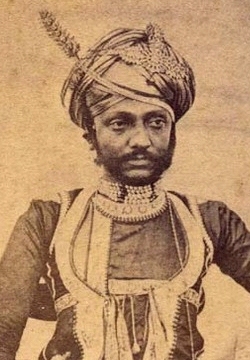 1846 - 1870 Thakore Shri Rawajiraj [Rawalji II] Prathirajji Sahib Bahadur, Thakore Sahib of Morvi. b. at the Darbargadh Palace, Morvi, 1828, only son of Thakore Shri Prathirajji Jayaji Sahib Bahadur, Thakore Sahib of Morvi, educ. privately. Succeeded on the death of his father, 1846. Ascended the gadi, at the Darbargadh Palace, Morvi. An enlightened ruler who began the development of his state, modernised revenue collection, reformed the administration and judicial systems, and also established the first modern courts. Mbr East India Assoc (London). m. Thakurani Shri Monghibakunverba Sahib. He d. at the Darbargadh Palace, Morvi, 17th February 1870, having had issue, two sons and two daughters:
- 1) H.H. Thakore Shri Sir Waghji II Rawalji Sahib Bahadur, Maharaja of Morvi (s/o Monghiba) - see below.
- 2) Kumar Shri Harbhamji Rawaji Sahib, of Mota-Khijadia and Rajwad. b. at the Darbargadh Palace, Morvi, 1863 (s/o Monghibakunverba), educ. Rajkumar Coll., Rajkot, and Trinity Coll, Cambridge (BA 1884, MA 1891, LLM), and Lincoln’s Inn, London. Barr-at-Law 1885. Probationer Bombay Presidency Civil Service 1884, transf Foreign Dept of the GOI 1886, Assist Cmsnr in the in Hyderabad Assigned Districts (Berar) 1890-1893, Civil Judge, actg Deputy Cmsnr Buldana 1892 and 1894 and Yeotmal 1894-1895, Administrator of Bharatpur State 1895-1896, prom Deputy Cmsnr Berar Cmsn 1896, Chief Minister of Bharatpur 1896-1898, Mbr Mahadraj Sabha and Head of British Relations for Udaipur state 1898-1901, Deputy Cmsnr Akola 1901-1903, and Buldana 1903-1905, Wazir of Nawanagar 1908. Presdt Girassia Assoc. Fellow Royal Statistical Soc 1885. Mbr Royal Asiatic Soc of GB & Ireland 1883, Royal Horticultural Soc 1884, National Indian Assoc, Shri Kathiawar Nirashrit Balashram 1907, etc. Rcvd: Delhi Durbar silver medals (1903 & 1911). m. at Varal, 11th April 1896, Kumarani Shri Kusumavati Sahib, daughter of Raol Shri Harisinhji Rupsinhji Sahib, of Varal, under Bhavnagar. He had issue, two sons:
- a) Kumar Shri Ranjitsinhji Harbhamji Sahib, of Mota-Khijadia and Rajwad. He d. at Rava Vilas, Rajkot, after September 1945, and may have left descendants, including (?):
- i) Maharaj Shri Manvendrasinhji Ranjitsinhji Jadeja [Manudada Sahib], of Mota-Khijadia. Acknowledged as the Maharaja of Morvi in 1979, by the nobles of the former Princely State, as the nearest male heir. Contested the succession to certain properties and assets by Rajmata Vijaykunverba in 1999. He had issue:
- (1) Kumar Shri Omkarsinh Manvendrasinhji Jadeja, educ. Rajkumar Coll, Rajkot.
- (2) Kumar Shri Arjunsinh Manvendrasinhji Jadeja, educ. Rajkumar Coll, Rajkot (1968). He has issue, a son:
- (a) Kumar Shri Ajayrajsinhji Jadeja, educ. Sunshine Sch, Rava Vilas, Rajkot, and Saurashtra Univ (B.Com, LLB 1999), Junagadh.
- (1) Rajkumari Amrapali Devi. m. Kumar Shri Mayurdhwajsinhji Kishorsinhji Zala, second son of Kumar Shri Kishorsinhji Balvirsinhji Sahib, of Lakhtar, by his wife, Kumarani Jaychandra Kunwarba, daughter of Thakore Shri Prabhatsinhji Bhupatsinhji, Thakore of Shahpur. She had issue, two daughters - see India Non-salute (Lakhtar).
- b) Maharaj Shri Prabalsinhji Harbhamji Sahib, of Dharuvnagar (ex- Rajawad). He had issue:
- i) Kumar Shri Prahladsihji Prabatsinhji Sahib, of Dharuvnagar. m. Kumarani Shri Giridharkumari Sahiba, daughter of Thakur Shri Kushal Singh, of Geejgarh, under Jaipur.
- i) Rajkumari Bai Shri Nirmal Kunverba Sahib [Raj Rani Ba Shri Nirmal Kunverba Sahib, of Hampur]. b. 1st November 1929. m. 25th February 1955, Raj Rana Shri Kanaksinhji Shivsinhji Jhala, of Hampur (b. 16th September 1932), fourth son of Raj Rana Shri Shivsinhji Govindsinji Jhala, of Hampur, under Dhrangadhra, by his third wife, Raj Rani Ba Shri Raj Kunverba Sahib, a lady from Ganod, under Rajkot. She had issue, one son - see India (Dhrangadhra).
- 1) Kunveri Bai Shri Nanibaunverba Sahiba.
- 2) Kunveri Bai Shri Vakhtubakunverka Sahiba [H.H. the Rani of Porbandar]. m. H.H. Maharaja Rana Shri Bhavsinhji Madhavsinhji Sahib Bahadur, Rana Sahib of Porbandar (b. at Porbandar, 26th December 1867; d. 10th December 1908), only son of Patvi Namdar Kumar Shri Madhavsinhji Vikramatji Sahib, Heir Apparent and sometime Regent of Porbandar, by his first wife, Kumarani Shri Majirajba Kunwarba Sahiba, daughter of Kumar Shri Jethaji Raghoji Sahib [Jethibha], of Dabhasang, under Nawanagar. She d.s.p. - see India (Porbandar).
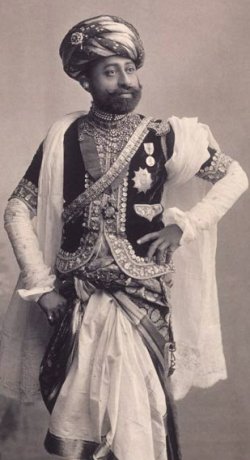 1870 - 1922 H.H. Maharaja Shri Sir Waghji II Rawaji Sahib Bahadur, Thakore Sahib of Morvi, GCIE (31.7.1897, KCIE 30.6.1887). b. at the Darbargadh Palace, Morvi, 17th April 1858, elder son of Thakore Shri Rawajiraj [Rawaji II] Prathirajji Sahib Bahadur, Thakore Sahib of Morvi, by his wife, Thakurani Shri Monghibakunverba Sahib, educ. Rajkumar Coll., Rajkot. Succeeded on the death of his father, 17th February 1870. Reigned under a Council of Administration until he came of age and was invested with full ruling powers, at the Darbargadh Palace, Morvi, 1st January 1879. Attended the Imperial Durbar at Delhi, where he was granted an increased salute of 11-guns, 1st January 1877. Attended the Golden Jubilee celebrations of the Queen-Empress Victoria in London 1887, the Diamond Jubilee in London in 1897, and the Coronation Durbar in Delhi in 1903. Raised to the rank of a first class ruling prince 16th February 1887, and granted the personal title of Maharaja. Received a sanad of adoption, 15th October 1890. An enlightened and well-educated ruler who built his state into one of the most prosperous in Gujarat. He constructed railways, bridges, and roads; modernised the capital with public buildings, electric lighting, gardens and streets; introduced tramways and telephonic communications, and a steam printing press; hospitals and dispensaries, colleges and schools, poor houses and an orphanage. The Morvi station remains one of the most beautiful examples of railway architecture, and the suspension bridge, a marvel of nineteenth century engineering. Hon. LLD. Mbr Royal Asiatic Soc of GB & Ireland 1883. Rcvd: the Prince of Wales’s silver medal (1875), KIH gold medal (1877), Golden Jubilee (1887 and 1897 clasp), and Durbar (1903 and 1911) medals. m. eight wives, including (first) at Morvi, 11th May 1874, H.H. Palitanawala Maharaniji Shri Bajirajbakunverba Sahib (d. at the Nazzarbagh Palace, Morvi, 25th September 1917), daughter of Thakore Shri Pratapsinhji Sahib, Thakore Sahib of Palitana. m. (second) at Morvi, 11th May 1874, H.H. Saylawala Maharaniji Shri Hamjikunverba Sahib [Ranijiba Vahu Sahiba] (d. at the Nazzarbagh Palace, Morvi, 24th November 1910), fifth daughter of Meherban Dostan Thakore Shri Kesharisinghji Sahib, Thakore Sahib of Sayla. m. (third) H.H. Tharadawala Maharaniji Shri Vahukunverba Sahib (d. at the Nazzarbagh Palace, Morvi, 24th November 1910), daughter of Rana Shri Khengarsinhji Vanaji, Thakore Sahib of Tharad. m. (fourth) (morganatic?) Shrimati Kashi Kunwarba. m. (fifth) H.H. Chudawala Maharaniji Sahib, daughter of Thakore Shri Becharsinhji Raisinhji Sahib, Thakore Sahib of Chuda. m. (sixth) H.H. Maharaniji Shri Manibaikunverba Sahib (d. young, at the Nazzarbagh Palace, Morvi). m. (seventh) (morganatic?) Shrimati Prem Kunwarba. m. (eighth) … He d. at the Darbargadh Palace, Morvi, 11th June 1922, having had issue, six sons:
- 1) H.H. Maharaja Shri Sir Lakhdhiraji [Jilubha] Waghji Sahib Bahadur, Maharaja of Morvi (s/o Bajirajbakunverba) – see below.
- 2) Kumar Shri Ajitsinhji [Hemubha] Waghji Sahib. b. at the Nazzarbagh Palace, Morvi, 9th September 1883 (s/o Bajirajbakunverba), educ. Harrow Sch, Middlesex, and Oxford Univ (BA), Barr-at-Law. Rcvd: Coron medal (1911 and Durbar bar). He d.v.p. 6th July 1916.
- 3) Kumar Shri Chandrasinhji Waghji Jadeja.
- 4) Kumar Shri Shivasinhji Waghji Sahib. b. at the Nazzarbagh Palace, Morvi, 22nd April 1911 (s/o Kashi Kunwarba). m. Kumarani Jiranba Sahiba, of Jaipur. He had issue:
- a) Kumar Shri Pruthvirajsinhji Shivsinhji Jadeja. m. Kumarani Alkaba Sahiba, daughter of Captain Kumar Shri Raghunath Sinhji Jhala, by his wife, Kumarani Kusum, nee Mehta. He had issue, a son:
- i) Kumar Shri Mahipalsinhji Pruthvirajsinhji Jadeja [Kumar Mahipal Sinh P. Jadeja]. m. Kumarani Nalini Kanwarba Sahiba, daughter of Thakur Narender Singhji Rajawat, of Chandroli, in Jaipur, by his wife, Thakurani Puran Kanwar, daughter of Rao Raja Balwant Singh [Lalaji Sahib], of Jodhpur. Copyright© Christopher Buyers.
- 5) Kumar Shri Pratapsinhji Waghji Jadeja (s/o Kashi Kunwarba). m. Kumarani Rajkumariba Sahiba Jadeja, daughter of Thakur Sher Singhji Kachwaha, of Chandroli, under Jaipur. He had issue, two sons:
- a) Kumar Shri Rajendra Sinhji Pratapsinhji Jadeja. m. Kumarani Umaba Sahiba, from Udaipur.
- b) Major Kumar Shri Jaswant Sinhji Jadeja. m. Kumarani Sangitaba Sahiba Jadeja, from Baroda. He had issue, a son and a daughter:
- i) Kumar Shri Aditya Jaswant Sinhji Jadeja.
- i) Bai Shri Saumya Jadeja. m. ... Sodha .
- 6) Kumar Shri Amarsinhji Waghji Sahib. b. at the Nazzarbagh Palace, Morvi, 29th June 1913 (s/o Mayurba). m. Kumarani Manohar Kumari. He had issue, three sons and a daughter:
- a) Kumar Shri Ajitsinhji Amarsinhji Jadeja. m. Kumarani Gajendra Rathore of Jhabua. He has issue, one son:
- i) Kumar Shri Dronsinhji Ajitsinhji Jadeja [Dron Jadeja].
- b) Kumar Shri Pritisinhji Amarsinhji Jadeja. m. Kumarani Nisha Sahiba, from Bombay. He had issue, one son:
- i) Kumar Shri Priyash Pritisinhji Jadeja.
- c) Kumar Shri Dilipsinhji Amarsinhji Jadeja. m. Kumarani Seemaba Sahiba, daughter of Kunwar Shri Narendra Sinhji Tanwar, by his wife, Kunwarani Sukanya Kumari, of Kurukshetra. He has issue, one daughter:
- i) Bai Shri Yasna D. Jadeja.
- d) Bai Shri Jaswantikunverba Sahib [Shrimati Jaswanti Kavathia]. m. Shri Kirit Kavathia. She had issue, one son and one daughter.